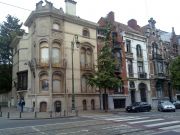
I had just over half a day in Brussels, which isn’t enough to see everything even though it's a fairly compact city, so I decided that I’d concentrate on exploring some Art Nouveau buildings.
|
 |
|
 |
|
|
 |
|
|
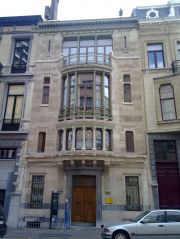
Hotel Tassel - the first Art Nouveau building
|
|
Brussels had a major expansion at the end of the 19th Century when Art Nouveau developed, and it appears to have become fashionable for individuals and some organisations to have houses and other buildings constructed for them in the style. So there are concentrations of AN houses in a number of suburbs on the outskirts of the city.
I had limited time so concentrated on looking at some of the buildings in the city centre and also went out to the St Gilles suburb where there are a number of the most important buildings and where the museum dedicated to the leading Art Nouveau architect, Victor Horta, is located.
|
|
| Favourite spots: |
|
|
 |
|
|
|
|
|
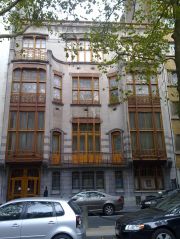
Hotel Solvay by Victor Horta
|
|
Travelling round Brussels is fairly easy. The city centre itself is quite compact and can be explored on foot. The city has a good, cheap, public transport system with buses, trams and a recently expanded metro system. Although I took the metro out to the suburb, I travelled back to the city centre by tram which was the best way to travel as the trams were frequent, comfortable and had large windows which allowed me to take in some views during the journey.
I took the metro to the Horta station and then walked up the Chaussee Waterloo and then the Chausee Charleroi up to the Rue Americaine where the Horta Museum is located. The walk took about 10 minutes. However, on reflection, it would have been better to take the tram
|
|
| What's really great: |
|
|
 |
|
|
|
|
|
Horta Museum - Rue Americaine
|
|
Horta Museum:
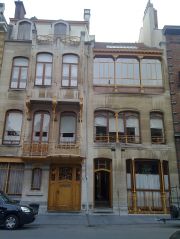
Victor Horta was a leading Art Nouveau architect who designed the first building in the AN style. The museum is in the house Horta designed for himself and where he lived between 1902 and 1919 (interrupted while he lived in exile during WWI). The outside of the building is not that remarkable compared to, say, the Hotel Tassel, but there are a number of interesting features – particularly the large windows, the ironwork balconies, the delicate wrought iron columns and the doors.
The museum actually occupies two buildings – the main house and the adjacent studio. Going inside allows you to get a feel for AN architecture and interior design. The house is built around a central staircase, lit by a large skylight, from which the main rooms could be accessed. The rooms have been restored and decorated in period style.
|
|
| Sights: |
There are many buildings scattered throughout the Saint Gilles district. The ones I saw included:
The Hotel Tassel, at No 6 Rue Paul-Emile Janson, was the fist Art Nouveau building, designed by Victor Horta in 1893-1894 for a wealthy scientist Emile Tassel.
The Hotel Solvay, 224 Avenue Louise, is another well known Horta building, designed for Armand Solvay, the son of Ernest Solvay, the inventor of the Solvay process.
The Hotel Hannon, 55 Avenue Brugmann, designed by Jules Brunfaut, houses the Musee de Contretype, which shows photographic exhibitions. I was hoping to take a look inside, but, unfortunately, it’s closed on Mondays and Tuesdays.
Les Hibboux - next door to the Hotel Hannon. The windows are particularly striking.
The house at 157 Rue de l’Aqueduc, designed by Horta for his friend Sander Pierron.
Maison Ciamberlani, 48 Rue Defacqz, designed by Paul Hanka
Hanka's own house (pre-Art Nouveau in style) is also on Rue Defacqz at No. 71
|
|
| Restaurants: |
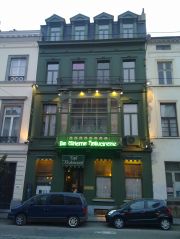
Da Ultieme Halucinatie, 316 Rue Royalle, not far from le Gare du Nord. An Art Nouveau restaurant - the interior is particularly interesting.
|
|
| Other recommendations: |
|
|
 |
|
|
|
|
|
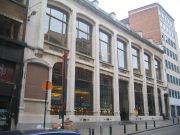
Horta’s Waucquez Store building - the Belgian Comic Strip Museum
|
|
In the city centre
Horta’s Waucquez Store building in rue des Sables, which now houses the Belgian Comic Strip Museum. Entry to the ground floor spaces is free and if time is limited its worth a peek inside.
Across the road on Rue des Sables, the former Le Peuple building, now housing another comic museum.
|
|
Published on Sunday October 4th, 2009
|
|
 Publish on Facebook
|
Tue, Oct 06 2009 - 10:46 PM
 by jorgesanchez
| Very useful, thank you very much |
Tue, Oct 06 2009 - 08:52 AM
 by krisek by krisek
| Nice report, Michael. I must have been to Brussels over a 100 times, hehe. Thank you for your views, and hints. |
Mon, Oct 05 2009 - 03:26 AM
by mistybleu
| A lovely report; it is so nice to see another side of a city through someone elses eyes. |
| Information: |
| Login if you are a member, or sign up for a free membership to rate this report and to earn globo points! |
|
| Belgium |
|
|
|
| France |
|
|
|
| United States |
|
|
|

|