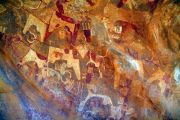
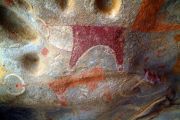
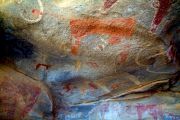
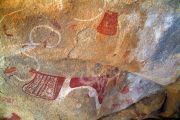
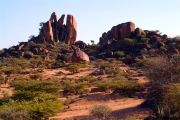
This report is about Somaliland and not about Somalia. Globosapiens, unfortunately do not have the correct flag or tag to apply for this report. I went to Somaliland to the caves of Las Geel. They house superb prehistoric rock art.
|
Somaliland separated from Somalia, when the federal government collapsed and the war in Mogadishu erupted. Somaliland is peaceful. It has its own parliament, president, government, currency, set of laws and regulations. It is ethnically homogenous, and it keeps out of trouble.
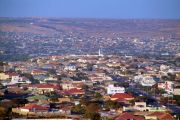
Hargeisa, the capital of this unrecognised state, was small and dusty. It did not resemble a state’s capital city.
I visited the Ministry of Tourism & Culture, which was based in a concrete single storey square shack. The Minister insisted on shaking my hand. His deputy, issued me a tourist travel permit and the access papers to the rock painting sites. Then he asked:
- Have you got a soldier?
- I have two, I replied.
- Oh, good, he said. That is enough, he added.
- Is it? I asked ironically.
- Yes, he responded without any reaction to my slight sarcasm. In that case, you must not only visit Las Geel, but also Dhagax Guure, which is better!
I had to negotiate with my driver to take me there. He was not really forthcoming. I had to remind him that the hotel gave me the car for the entire day and if there was going to be time, we should not ignore the ministerial order. He eventually agreed.
The vast majority of the vehicles had the steering wheel on the right, but the traffic was on the right side. So, either the wheels were on the wrong side or they were driving on the wrong side of the road.
Apart from prehistoric rock art, the coastline and the bushland, there is nothing particularly significant to see in Somaliland. People are the state's greatest asset.
|
|
| Favourite spots: |
LAS GEEL
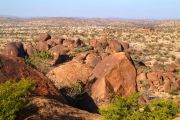
A four wheel drive vehicle with plenty of clearance was necessary. Although the road from Hargeisa to Berbera was alright, the bush track to the prehistoric rock art led through two rivers. The rivers were dry but their banks were steep.
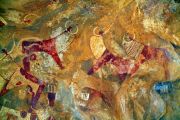
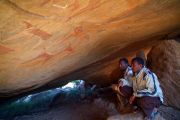
The trail to the painted caves was short and easy. The drawings were so vivid and in such an incredibly excellent condition that I would believe that they were just made yesterday. The caves were remarkable. I have never seen anything like that. The art bore no human damage. Some, and part of some, of them were impacted by weather though, which affected either the colour or the drawing's shape. I snapped a few photographs in each cave. It was easy. The pigments were bright and looked remarkably fresh. Almost as if there were done a few days before, and not 5000 or 6000 years ago. Most of the caves depicted people with animals. The creatures were mainly cows, goats and dogs. No wild animals at all so, clearly these were farmers', not hunters'.
|
|
| What's really great: |
DHAGAX GUURE
After lunch, I went in the exact opposite direction from Hargeisa to Dhagax Guure. As the minister planted a guide with me, I rested assured that finding the site was not going to be an issue. Oh, no no no! I was wrong! The guide had no clue. And my driver had never been there either.
The driver cruised in the bush on unmarked and barely visible sand tracks for about an hour. Only twice did we come across some people, who were busy around their simple households. They provided rough and rather vague directions, but they did not know much about what I was looking for.
When I eventually arrived close enough to the place, thanks to some random people in the bush closer to the caves, the watchmen were not at the site. Only them knew exactly where the best drawings should be. All that blindfolded driving for nothing. I seriously expected that the guide the minister gave me would actually know something. Two local farmers showed me two caves. Yet, I loved the area.
|
|
| Sights: |
Hargeisa has little to offer. There are not any prominent sights in the city. It is a sort of a one horse town. Apart from interesting mosques, there is little to see in the capital. The landscape around is barren and despite a two conical mountains resembling female bust, there are no remarkable landscape features around. It is a typical desert town, which looks almost as if slapped together in a hurry, which suddenly became a capital of a country.
One has to go to Berbera to see the coast and some historical buildings. I did not go, though. Instead, I went on driving around in the bush looking for more prehistoric rock art.
|
|
| Accommodations: |
The Ambassador Hotel (USD 42) was squeaky clean and looked very professional. The service was superb. The room had floor tiles, a sat TV, air-con, fridge, immaculate shower, quality rugs and comfy bed. As soon as I dropped my bag, I went down to the garden to eat something. It was only 4:30pm but the restaurant obliged happily.
I hesitated about the steak but I chose it anyway. Of course what actually arrived was not a steak that I expected. Instead, a flat (definitely pounded) piece of meat arrived with a trace of thick brown sauce. It was delicious! The meat was slightly less juicy that I normally like my steaks but it was not chewy and the pepper sauce was almost perfect - spicy, tingy, a little sweet. I was already thinking of having the same dish the next day!
At the hotel, I arranged a trip to Las Geel, which meant renting a 4x4 vehicle and two escort boys, e.g. armed soldiers, who were supposed to bodyguard me during my escapade to the Somalilandese wilderness.
|
|
| Nightlife: |
There is no nightlife in Somaliland. It is a dry land, and since there is no booze in the country 'dry' extends its meaning to include the colloquial term. Well, this does not automatically mean that there is absolutely no action at all at night. The UN personnel present in the country organises parties in a more European or US style just to keep them happier with their presence in Somaliland. And of course, for the New Year's Eve, they wanted to keep up with the tradition.
Downtown, there are no pubs, clubs, discos, which would typically cater for the night owls. Yet, if nightlife could be brought forward a few hours, then there were a few eateries and stand-up bars serving soft drinks, which acted as venues for congregation for the locals.
|
|
| Hangouts: |
|
This includes a few restaurants, which double for bars, but I failed to see any of them. I only stayed two nights in the country, and one of the nights was rather rough, anyway. I had to organise transport to get out of the country, since my New Year's Eve flight was cancelled. I had no time to venture into Hargeisa at night looking for some social life and meal out. The restaurant at the hotel, where I was staying was superb, set in the garden, is frequented by the expats. Downtown, a few 'better' restaurants welcome both, and are also complemented by a patio or garden, where people sit outside, sip their tonics, and catch up on their gossip. I went to one of them between my trips, and I was immediately very popular. Local 'businessmen' and locals, who could afford to eat there, approached me very friendly and showered me with questions about everything and invitations to join them for a drink in the afternoon.
|
|
| Restaurants: |
|
Unfortunately, I fell in love with the restaurant at the Hotel Ambassador and did not have to explore farther in the field. For lunch I stepped into a local restaurant, which was considered to be one of the more expensive ones. It was located just off the main road - the Independence Avenue, close to the Ministry of Culture and Tourism. It was set around a garden and had a couple of open patios for those private business meetings. A local dish meal for four cost 120,000 Somalilandese schillings (USD 20), which included pasta with goat meat and spicy tomato sauce and four soft drinks. No, I did not have four meals... I catered for my team driving and escorting me around the area, which included a guide, two armed guards and a driver.
|
|
| Other recommendations: |
My recommendation is to go and explore. It is a safe country to travel to and people are fantastic. Many went a few miles out of their way to help me with my logistics - withing the country, but also helping me enormously to leave the country in time for a party in Djibouti. Somaliland is certainly significantly off the beaten track, of course, but the experience to venture there is highly rewarding. It definitely changed my view on the Horn of Africa, so terribly thorn by wars.
If you would like to know more, you should visit my website: www.krzysztof-dudek.com where you will find a full report from this trip (including Ethiopia, Djibouti and Eritrea) - you will need a password to the travel reports site, so let me know if you are interested and I will let you have it.
|
|
Published on Sunday February 10th, 2008
|
|
 Publish on Facebook
|
Fri, Mar 14 2008 - 01:52 PM
 by alfonsovasco
| you go to incredible plasces |
Mon, Feb 11 2008 - 10:37 AM
by rangutan
| Another well written and excellent report. you are on the way to becoming a valuable member. Your images are stunning, considered loading some to the main gallery? |
Mon, Feb 11 2008 - 07:47 AM
by rmoss
Your photographs of the rock art are fantastic. If they were labelled as Jan Miro works in a gallery I would be totally convinced. Talk about life coming full circle. Do you have any other photographs you can upload?
How accurate is the age of the artwork? Do the locals still keep cows and goats similar to those depicted? Are there any local legends as to why and when the paintings were made? |
Sun, Feb 10 2008 - 08:21 PM
by mistybleu
| An excellent report, however you may have been scored low because it was uploaded under an incorrect name/county. You should suggest the name to the team at Globo so we can have accurate informatons. |
Sun, Feb 10 2008 - 07:28 PM
by jorgesanchez
Before voting this report I saw 3 points. This report deserves 5 points for many reasons, First: very few people in the world have been in Hargeisa. Second, it is very well written. The member who gave 3 points has no idea of the whereabout is Hargeisa and the troubles to travel there.
Thanks for discovering us these caves! |
| Information: |
| Login if you are a member, or sign up for a free membership to rate this report and to earn globo points! |
|
| Albania |
|
|
|
|
|
|
 |
| Antigua and Barbuda |
|
|
|
| Argentina |
|
|
|
|
|
|
|
| Armenia |
|
|
|
| Aruba |
|
|
|
| Australia |
|
|
|
| Austria |
|
|
|
| Azerbaijan |
|
|
|
| Barbados |
|
|
|
| Belgium |
|
|
|
|
|

|