Sint Maarten or Saint-Martin, is an island that has been split between France and The Netherlands for centuries, and despite occasional trouble in Europe, the relations between the neighbours on the island were almost always fine. But split is visible.
|
 |
|
 |
|
|
 |
|
|
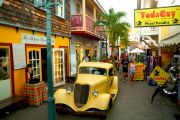
Narrow street in Philipsburg
|
|
The island is split into two dependent territories – the Dutch colony, part of the Dutch Antilles – called Sint Maarten, and the French department called Saint-Martin. The border between those two does not exist, as it practically does not in Europe, since both France and The Netherlands are part of the European Union, and both singed the Schengen Agreement.
I immediately felt the charm of the island. Well, to be completely honest, first I could not believe the chaos with the taxis at the international airport on the Dutch side. Then, I was definitely unimpressed with the traffic. And yet, when I arrived in Philipsburg, I knew it was a very good decision to come to the island. It was relaxed, well maintained and definitely felt more Caribbean than the fellow islands of Curacao and Aruba, both with Dutch influences. Uh, and the taxi driver who took me from the airport did not speak any of the local languages but English with a very typical Caribbean accent.
I did not have any specific expectations. I heard little about Sint Maarten. I read very high level information about the country. And I might have seen only a couple of bad photographs of Philipsburg. So, I had no preconceptions or prejudice. The downside was that I had no idea what to do there either...
I quickly realised that many visitors to Philipsburg were coming for the jewelry. The main street in town was lined with diamond dealers, offering apparently better deals than those in Amsterdam or Antwerp. I did not check any of them. I would have wasted a long time waiting my turn in those shops.
|
|
| Favourite spots: |
|
|
 |
|
|
|
|
|
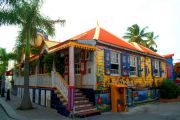
Colourful architecture of St Maarten
|
|
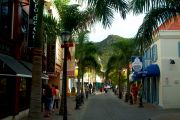
However, I felt so at home when I saw the plenitude of waterfront bars and restaurants. My jaw almost dropped when I drove onto Philipsburg main street. It was a narrow, single-lane, one way avenue lined with fine palm trees and excellent shops. Colonial Dutch architecture adapted to the heavenly Caribbean climate just complemented the overall charm!
I definitely missed the beachfront bars, restaurants and clubs. After spending a few days in Aruba, when such bars were restricted to residents of expensive hotels, and in Curacao, where there were no good beaches, I really welcomed the opportunity to sip sundowners on the sand, listening to the music and watching the sun go to bed.
Very quickly the Philipsburg's beachfront became my favourite area. I was imagining myself on a longer party holiday there, if such holidays were to become my thing in a future. For now, I prefer exploratory trips with plenty of discovering rather than lounging on a beach for days.
|
|
| What's really great: |
|
|
 |
|
|
|
|
|
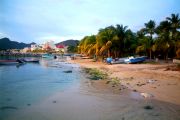
Waterfront of Philipsburg
|
|
As soon as I miraculously checked in at the most chic (and the first ever) hotel of Philipsburg, the Pasanggrahan Royal, I stepped on the beach and almost jumped in awe. The town beach was superb and a megaclean beach level promenade separating the beach sand from the hotels' and households' buildings was a pleasant surprise. I loved that esplanade. It was so civilised! Some of the beach-front bars and eateries placed comfy couches and armchairs directly on the beachsand among baby palmtrees. How cool was that?
There was part of the beach, which was less built up. There was a small palm-planted passage between the shore and some shops and simple bars. Two faces of a seafront so close one to another. And what I liked best was that neither part of the beach was particularly crowded.
|
|
| Sights: |
In addition to the grand and colourful buildings on the main street, I went to see the historical Philipsburg. It was simply part of the marina lined with old wooden houses now converted to shops, restaurants, bars and a terrible casino. One of them was a rather poor yachtclub for the rich and want-to-be-famous. It was unfriendly. Terribly unfriendly! I cannot remember if there was any other place in the world that I felt so unwelcome before. Surely, I did not have a yacht, was only passing through and just wanted a couple of drinks that's all. Perhaps it was too obvious that I was not planning to spend an astronomical amount of money there. What kind of a customer was I then?
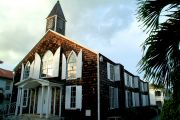
In the centre, there were a couple of nice looking churches. One kept in a European style, the other in an American. And apart from them, and a few interesting houses, there was nothing else terribly interesting to see in the capital.
|
|
| Accommodations: |
|
|
 |
|
|
|
|
|
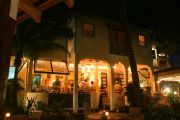
Pasanggrahan Royal Hotel's waterfront garden and terrace restaurant
|
|
Staying at the Pasanggrahan Royal, was not cheap. But I did not make any hotel bookings before landing on the island. I was actually lucky that they had a single room available for me. It was rather spectacular. The decor was kept in a 1930s style with a few reed-woven furniture. The bed was huge. The table and a stylish armchair were comfortable, and the bathroom was superb. The air-conditioning was efficient but the best thing was the ottoman on the balcony, where I could stretch my legs and listen to the people stirring downstairs on the beach.
The hotel was famous and staying there, rather in one of the newer (and more expensive), marble tiled establishments, did make an impression on the taxi drivers. It was so stylish and plush! But it came with a fat bill (about USD80).
Downstairs, the hotel had a very nice restaurant and a bar, both of which were closing rather early, but it was in a very good taste to be seen dining and drinking there.
|
|
| Nightlife: |
|
|
 |
|
|
|
|
|
Main shopping street in Philipsburg
|
|
In the evening, the beach-front of Philipsburg entered into its different form of life. Many of the bars sponsored bands to play live, some of which were quite good when sticking to easy songs. Others tried to perform more ambitiously with rather mixed results. So mixed that I could not really listen to it, and I moved on.
It is difficult to describe the atmosphere on the beach at night. It was converting into a large and very cool lounge. The bars were full of holidaymakers simply chilling over cold drinks, chatting and chirping. Some were sitting on the sand, some stretched on the sofas under the palm trees, some stood by the bands, some leaned on the bars, and some rested on the armchairs by the tables on some of the balconies. Fortunately (I'm sorry if I am being overly critical) some of the bars relied on their mechanical music and played chillout tunes, whose sounds complied in harmony with the movement of the palmtrees on the beach. It was such a great seafront indeed.
|
|
| Hangouts: |
|
|
 |
|
|
|
|
|
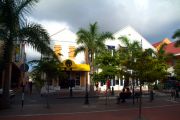
A little square in Philipsburg
|
|
I had an early flight in the morning so could not stay too long hanging out in the beach bars at night. So, I eventually landed in an extremely comfortable ottoman on my personal verandah attached to my hotel room. If the crimson bougainvillaea had not grown so tall I would have enjoyed the view of the beach. Instead, I lied down out of anyone's sight and listened to one of the bands playing at the Get Wet Bar. This one was not too bad at all, I think.
I guess Philipsburg made a great impact on me as it was the first town so far on my holiday with beach-front facilities, bars, restaurants, shops, etc. First in three months of travelling!
|
|
| Restaurants: |
|
|
 |
|
|
|
|
|
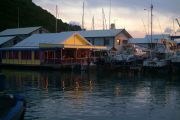
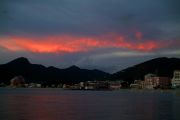
A night falling on St Maarten
|
|
I also crossed to the French side of the island with the aim to have breakfast at one of Marigot's countless cafes. Surprisingly, the French side appeared much less developed and seriously underinvested. Whilst Sint Maarten appeared like a separate state of the Netherlands, with its own flag and currency, Saint Martin definitely demonstrated that it was a French Department, fully integrated with the Republic of France, flying the blue/white/red French flag, dealing in euro and riding French car registration plates.
There were a few colonial French buildings around but not enough to create an elegant ambiance. It was a pity.
I was also hoping for a larger number of French-style cafes and bars. I could not even see the French baguette breads around. The eateries were opening very late as well. I could not make up my mind where I should sit down and relax, breakfasting on something hybrid, combing French and local cuisine. So, overall rather disappointed.
|
|
| Other recommendations: |
|
|
 |
|
|
|
|
|
A church overlooking a small square in Philipsburg
|
|
My taxi driver did not speak Spanish, which I found interesting. He was hopeless avoiding traffic or entering one way street wrongly. He also told me in his heavy Caribbean accent that he could not hate more doing jobs for the local people. He did realise it was racist but could not helping telling me. He mentioned that the locals often lived in difficult to reach places, on dirty roads and carried smelly bags. He said it was ruining his van and leaving it smell of fish or dead goats. Apparently locals carried a lot of dead meat and fish with them (sic!). Tourists, like me, on the other hand, were always clean, headed to civilised places and had money. Yes, he told me he had been tricked on many occasions that the locals had not had enough money or had relied on friends or relatives at the destination to pay, who either had not had money either, had not been at home or had never existed at all.
Taxis are easily found in front of one of the churches but one has to negotiate with them!
|
|
Published on Saturday January 31th, 2009
|
|
 Publish on Facebook
|
Sun, Feb 01 2009 - 12:09 PM
 by basia
| Interesting information Krys, I probably looked at me to diamonds, hehe, and I love bougainvillaea could cover the entire balcony ;-) |
Sun, Feb 01 2009 - 09:05 AM
by porto
| I like the colourful architecture and the hotel sounds 5***** the same goes for this report. |
Sun, Feb 01 2009 - 03:52 AM
by pesu
| The beach and the ottoman behind a crimson bougainvillaea really seem to be fine places for some 'lounging' days of vacation. :) |
| Information: |
| Login if you are a member, or sign up for a free membership to rate this report and to earn globo points! |
|
| Albania |
|
|
|
|
|
|
|
| Antigua and Barbuda |
|
|
|
| Argentina |
|
|
|
|
|
|
|
| Armenia |
|
|
|
| Aruba |
|
|
|
| Australia |
|
|
|
| Austria |
|
|
|
| Azerbaijan |
|
|
|
| Barbados |
|
|
|
| Belgium |
|
|
|
|
|

|