I happen to have friends in Didcot. It suited me well that there was a direct railway connection, the Great Western Railway, between Bath, the city I lived for 9 months, and this quiet Oxfordshire city. But, what is so special about Didcot?
|
 |
|
 |
|
|
 |
|
|
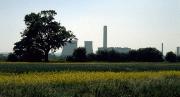
Didcot Power Stations, designed to fit in the environment
|
|
Didcot is an old city, although it remained a small rural village for hundreds of years. The first settlements are found on the ridge that runs through the city, and during the roman times, the surrounding marshlands was sought dried by a huge ditch, which still is to be seen in the Ladygrove area.
It is of course the arrival of the railway in 1839 that changed Didcots history. The legend says that the landowner of the neighbouring city to the north, Abingdon, didnt want his dinner spoiled by noisy steam engines, and thereby denied his own town the growth that Didcot experienced. The first station was built in 1844, in the same style as London Paddington, which is the end station for GWML.
It is unusual for a small city of 25000 to have skyline, but Didnt has. I am not talking about skyscrapers, but of power station chimneys. Didcot A and B are the big powerstations outside the city, particularly visible if you arrive from A34 and Milton Road. The main chimney of Didcot A is 199 meters, and the 6 cooling towers are 99 meters each.
The ashes from the power stations are used by the adjacent factory to produce building blocks. It is also possible to visit the power station and learn about their environmental program, ie how they gradually switch from coal to natural gas or biomass.
In Didcot there is also a number of other high technology companies, securing the area as a technological center. Among others, the Atomic Research Center in Culham (north of city) and Harwell laboratory (west of city).
The availability of work and the commuting possibilities via rail to Oxford and London, has made Didcot one of the areas for future growth in Oxfordshire.
|
|
| Favourite spots: |
|
|
 |
|
|
|
|
|
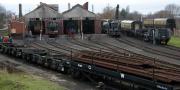
The shed at Didcot Raiway Centre
|
|
There are a few places of interest:
* Didcot railway center - the old engine shed which became redundant due to the rationalisation of the UK railways, as well as the gradual switch from steam to diesel power is now a museum with a collection of engines and stock, including a turning-pit. For more info, visit www.didcotrailwaycentre.org.uk/
* Berkshire Downs - an area of natural beauty, part of the horse shoe shaped North Wessex Downs AONB. Great diversity of flora and fauna, and includes the World Heritage Site of Avebury and the White horse of Uppington. More info: www.northwessexdowns.org.uk
* Power station visit. As mentioned above. For more info, visit http://www.npower.com/Education/Power_st-ation_visits/Didcot_A.html
* River Thames - not as big as we know it from London, but nevertheless, it here. To the north of city, on the way to Abingdon.
* Abingdon - nearby city with remains of an abbey from 7th century. The St. Helens church (built 1100) is 10 feet wider than its long.
|
|
| What's really great: |
|
|
 |
|
|
|
|
|
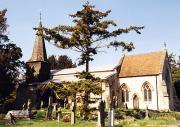
All Saints Church in Didcot
|
|
I spent most time with my friends when I visited Didcot. We usually went away for saturdays, but I have very pleasant memories of participating in a Trivia Car Rally. At that time I owned my own car, the F 481 SAD, which I called SAD SAM. We drove around Didcot, Abingdon, and other small villages, even churchyards, trying to solve the (for me) difficult questions.
|
|
| Accommodations: |
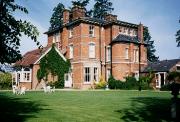
A small city like Didcot does not attract the big hotel chains. However, there are some smaller, private owned hotels:
* Steventon House Hotel, once owned by the sewing machine magnet, Sir Mortimer Singer. Tel: 01235 831223, Fax: 01235 834689, Email: steventonhouse@freeuk.com
* The Bear Hotel - Overlooking the historic marketplace of Wantage. www.thebearwantage.co.uk
* The Kingswell Hotel in Harwell, Tel: 01235 833043
|
|
| Hangouts: |
Shopping in Didcot is possible at these locations:
* The Broadway - Shops on one side only, estate agencies, takeaways, a couple of smart coffee shops, W.H. Smith, Boots, an optician, a butcher, a post office, banks, bakeries, dry cleaners.
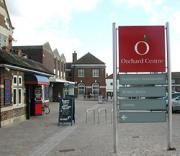
* The Orchard Centre - 30 stores; Woolies, Holland & Barratt, Clarks, Argos, Next, Superdrug, Robert Dyas, Thorntons, and a large Sainsbury's.
* The marketplace - street markets on fridays and saturdays, with farmers market every second saturday.
|
|
| Other recommendations: |
|
|
 |
|
|
|
|
|
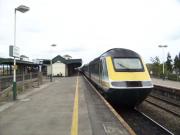
A Great Western Train at Didcot Parkway.
|
|
Although Didcot being a small city, I would probably choose this area if I was to settle down in Great Britain some day. You never know.... :-)
|
|
Published on Saturday September 9th, 2006
|
|

|
Sun, Sep 24 2006 - 01:00 AM
 by marianne
| Great report for trainspotters (and others as well) |
Thu, Sep 14 2006 - 02:04 AM
 by eirekay by eirekay
| Great report! You always have such wonderful photos! |
Mon, Sep 11 2006 - 12:29 PM
by st.vincent
| Good report Terje, a friend of mine has a large metal Didcot railway sign at home that he got when the station was renovated some years ago. |
Sun, Sep 10 2006 - 09:58 AM
by frenchfrog
| Yeah, Didcot is Heaven for all Trainspotters like me, it is also the "birth place" of the childhood book "Thomas the Tank Engine". Great report Terje! |
Sun, Sep 10 2006 - 08:07 AM
by davidx
| Great and imaginative, Terje. I should never have imagined anybody finding enough on Didcot to write a report. That just shows how wrong one can be! |
Sun, Sep 10 2006 - 03:51 AM
by mrscanada
| Loved reading about Didcot. The trains in the UK have changed since I was there. |
| Information: |
| Login if you are a member, or sign up for a free membership to rate this report and to earn globo points! |
|
| Czech Republic |
|
|
|
| Denmark |
|
|
|
| Iran |
|
|
|
| Italy |
|
|
|
| Norway |
|
|
|
|
|
|
|
|
|
| South Africa |
|
|
|
| Spain |
|
|
|
| Svalbard |
|
|
|
| United Kingdom |
|
|
|
|
|
|
|
|
|

|