A fascinating mix of natural beauty and architectural brilliance, Schloss Pillnitz is one of Dresden's biggest attractions.
Schloss Pillnitz
Some Background Situated in the middle of an idyllic park on the outskirts of the city, the castle - built by August the Strong in the 18th century - was used as a romantic getaway by the Saxon royal family. The main buildings display an intriguing mix of baroque and Far Eastern architectural styles and now house a collection of 13-20th century arts and crafts. A visit to the castle would not be complete without a walk through the gardens, which are full of exotic plants and trees as well as a host of red squirrels.
How to get there There is good public transport available from Dresden to Pillnitz but I recommend one of the more pleasant boat cruises from the Brühlsche Terrasse which takes you upriver (south-east) to the Schloss Pillnitz. (Please refer to other recommendations section below)
Transport connection: tram line 9 to final stop at Kleinzschachwitz, then by ferry to Pillnitz or by steamer from landing-place Dresden Terrassenufer.
Opening Times From May to October, both palaces are open from 10.00 to 6.00 pm. The Mountain Palace (Bergpalais) is closed on Mondays where as the Water Palace (Wasserpalais) is closed on Tuesdays.
Note: From November to April, the water palace is closed for the winter break.
Admission Fee Entrance to the Palace and Park is Free.
Favourite spots:
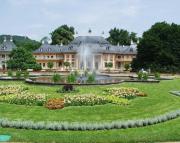
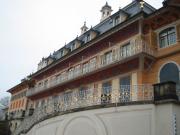
A close-up of the Wasserpalais.
The Saxon princes' summer residence has two main wings, the riverside Wasserpalais and the inland Bergpalais, separated by a formal French garden.
The Palace Ownership of the palace often changed. In 1694, it belonged to Prince Johann George IV. Then it came into the possession of King August the strong who at a large expenditure transformed it into a spectacular garden and castle. Often it is used for water sports in summer as it is by the banks of the Elbe River.
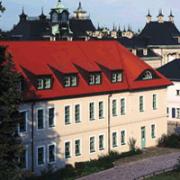
The transformation task was handed to one of the national building masters Matthaeus Daniel Poeppelmann. Between the years 1720 to 1723, an outside staircase was built at the water palace into the Elbe, opposite the Elbinsel. Then in 1724, the Bergpalais (mountain palace) was built. More playful than the Zwinger, the palace has a faintly Chinese air with its pagoda-like roofs. The exotic architectural style also blends some Indian architectural features and is sometimes called the "Indianisches Palais".
The Bergpalais houses a nice little arts and crafts museum (Museum für Kunsthandwerk) displaying the region's furniture, musical instruments, porcelain, crystal and pewter.
The Park Take a stroll in the English-style landscaped park that stretches north and west of the palace. The garden surrounding the Castle was built in 1780. A breathtaking sight in summer as seen from many photographs in tourist brochures and books about the castle. The beauty of the park, somewhat reminiscent of an English garden, is kept even until today. It would seem that no time as passed at all, with the colors of the castle glowing in orange as if new and with such a well groomed garden. It's almost like taking a step back into the renaissance days.
What's really great:
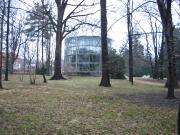
The glass enclosure in Winter
The English-styled landscape Park. The park is famed for its exotic species of tropical plants which were imported even in the 17th Century to add diversity to the plants in the park. One of the main attractions is the "kamelie" (camellia?) tree which was brought from Japan in 1770 and still grows in the park till today. The tree is protected in winter times by constructing a wooden enclosure that will prevent frost and snow from damaging its leaves and branches.
Today with modern technology, the tree is kept warm in a glass enclosure, with all the necessary ventilation to keep it green and healthy in winter. In spring and summer the tree is full of blossoms and is quite a sight to behold.
Sights:
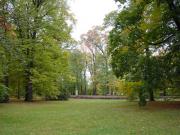
The lush green landscape of the Park.
One of the most interesting features of Schloss Pillnitz is the blend of oriental and western architecture. The Chinese influenced parvillions and staircases gives a somewhat playful ambiance and a contrast to the usual baroque design of Castles in Dresden.
The garden and the landscape park with camellia blossoms is also a beautiful sight in summer.
Accommodations:
Schlosshotel Pillnitz
Apart from ample accomodation options in Dresden there are also many Gasthaus and pensions in Pillnitz. Nearby the Palace there is a hotel.
Schlosshotel Schloß Schänke Pillnitz (Palace hotel Pillnitz) August - Böckelstiegel - Straße 10 01326 Dresden Tel: 0351/261 4 - 0 Fax: 0351/261 44 00
This isn't exactly a disco but I was told that its great for wine tasting and is quite lively in the evenings. Weinbergschänke Inh.: Henry Kreher Am Rathaus 2 01326 Dresden Tel: 0351/2618805
Hangouts:
Display of traditional costumes of the 18th Century at the Bergpalais
After asking around about pubs in Pillnitz, someone suggested this tavern. So heres the address and contact.
Taverne "Bei Jiannis" Der Grieche (Tavern "Bei Jiannis" The Greek) An der Schäferei 1 01326 Dresden Tel: 0351/2618989
Restaurants:
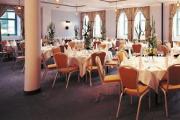
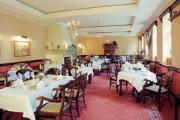
Fliederhof Hall
There are several nice restaurants around Pillnitz, the following are just to name a few.
Café Pillnitz Orangeriestraße 10 01326 Dresden Open from 11 a.m - 6. pm. Closed on Tuesdays.
Other recommendations:
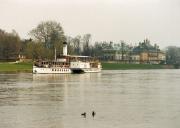
Steamers moving downriver.
The Elbe Cruise to Pillnitz Take one of the steamers frequently operating on the Elbe River to Pillnitz and arrive in a most pleasant way. From the landing-place at the Dresden Terrassenufer the journey takes about one and two hours.
Check out the Homepage of the Sächsische Dampfschifffahrt for more information about the Steamers that operate on the Elbe River. (Ferry Operators) http://www.saechsische-dampfschiffahrt.d--e